Deck Cadet Jobs at Sea: Current Vacancies, Salaries and Joining Dates
Deck Cadet Jobs at Sea: Current Vacancies, Salaries and Joining Dates
By Emily Carter
Every week, thousands of people who want to go to sea start the same search: "deck cadet jobs at sea." The phrase sounds simple, but behind it sits a career decision that shapes your training, your earnings and your working life for the next decade. A deck cadet is the first real step on the officer's ladder, and the way you secure that first berth matters almost as much as the certificates you carry. This article builds on the overview of the vacancy market and the verification checks, and goes deeper into the practical sequence that turns an interest in deck cadet jobs at sea into a confirmed joining date.

Why the Deck Cadet Berth Is the Hardest Step to Get Right
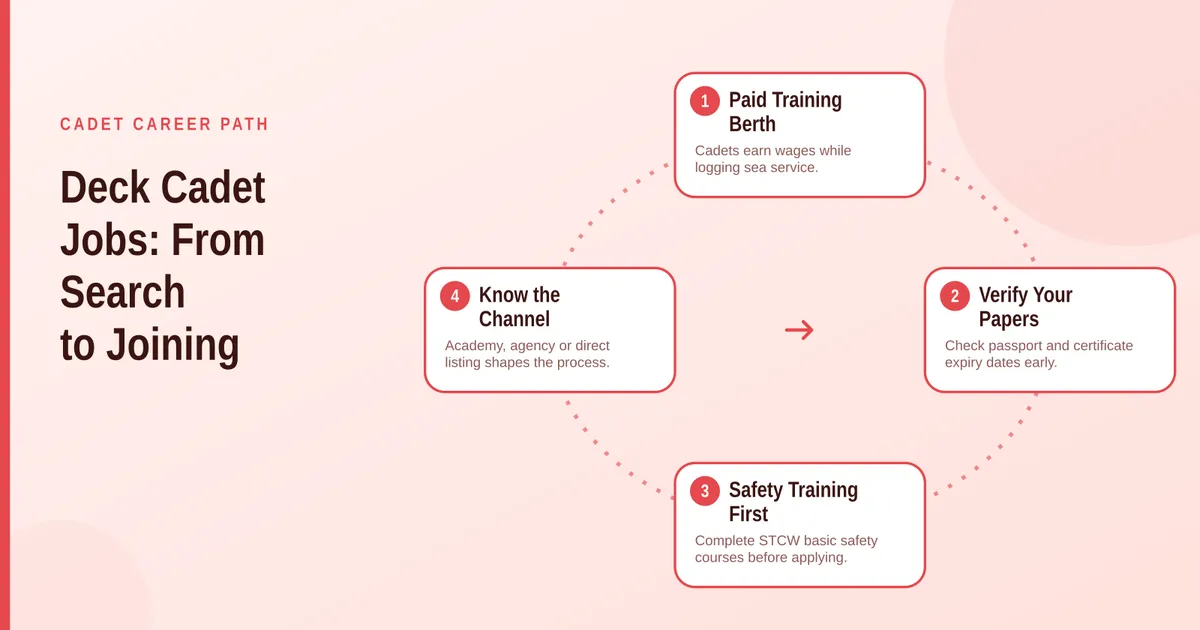
A deck cadet is a paid trainee on the deck department's officer track. Unlike a classroom-only academy placement, the cadet earns wages and accumulates sea service that counts toward the certificate of competency required for third officer. Cadets stand watches under supervision, keep logs, assist with mooring and cargo operations, and gradually take on tasks that carry real responsibility. The berth is therefore both a job and a training contract, and a candidate who treats it as a simple employment application will often miss the questions that matter most. For candidates comparing options, a dedicated listing platform such as SeaJobs.pro can help them see which deck cadet vacancies are open, what wages are offered, and when a berth is expected to start.
The earlier article on vacancy verification and salary comparison sets the framework for judging each offer, and the steps above show how to carry that judgement through to the signing stage
The difficulty begins with supply. Some cadet berths are advertised publicly, but a significant share is filled through referrals, academy networks and direct relationships between shipping companies and training institutions. Shipowners with structured cadet programmes usually recruit against a planned intake, while manning agencies place candidates against open requisitions from their principals. Knowing which channel a vacancy comes from tells you how much room there is to negotiate, how quickly the process will move and what documentation will be checked first.
What a cadet does on board is the reason employers screen so carefully. Day to day, the work covers watchkeeping under a qualified officer, participation in mooring and anchoring, routine cargo checks, and drills for fire, abandon ship and man overboard. Each of these tasks adds to the sea service record that the maritime authority later reviews. A candidate who understands how this record accumulates, and who keeps accurate documentation from the first day of joining, avoids the costly situation of arriving at a certification exam with gaps in the logbook.
What You Need Before Applying
The core document set is the foundation of any credible application. It normally includes a valid passport with enough validity remaining for the intended voyages, a seafarer's identity document, a medical fitness certificate issued by an approved doctor, basic safety training certificates under the applicable STCW framework, and any academy or training records showing prior sea time or relevant coursework. Scanned copies should be stored in a clearly named folder, with originals ready for the joining day. Expiry dates must be checked before the first application is sent, because an expired certificate can cancel a confirmed joining date at short notice.
Basic safety training is where many candidates discover gaps. Survival craft, fire fighting, elementary first aid and personal safety courses each have their own validity and provider requirements. The practical check is simple: confirm that the training provider is approved by the relevant national authority, that the certificate states the STCW competence it covers, and that the employer or agency accepts it. A certificate from an unrecognised provider may look correct on paper and still fail verification at the point of signing on.
Medical fitness is the item most likely to be rejected late. The examination assesses eyesight, hearing, cardiovascular health and general fitness for shipboard duties, and the detailed standards differ between flag states. A candidate who books the medical only after receiving an offer risks losing the berth if the result is unfavourable or if the certificate is issued for a shorter period than the contract requires. Checking the flag state's medical requirements before applying, and scheduling the examination early, removes that risk.
A credible application profile is built around sea-relevant content. The CV should list training and certificates by name and number, state physical fitness and any prior maritime or workshop experience, and present information in reverse chronological order. The cover note should be short and specific: state availability, the preferred joining window, and the exact status of each certificate. When applying through a platform such as SeaJobs.pro, the CV reaches the crewing manager directly, so accuracy and completeness from the first contact determine whether the application is progressed at all.
Step-by-Step: From Application to Joining Date
The usual sequence runs from application to screening, interview, offer, contract signing, travel and joining. The order is not always fixed. Some agencies make an offer before verifying medical status, while some owners require the medical and training checks before any interview. Each stage carries its own failure points, and a candidate who understands where the process can stall can prepare for those points in advance.
Screening focuses first on three things: certificate validity, medical status and availability. Recruiters compare the stated joining window against the principal's schedule, so a candidate who can join only after a fixed date may be passed over in favour of one who can travel sooner. The interview then tests safety awareness, teamwork and motivation. Concrete answers work better than general ones. A candidate who describes a specific drill from training, or explains how they handled a difficult shift during academy practice, gives the interviewer something verifiable to assess. Before applying, it is worth reviewing the current openings and their requirements on Deck Cadet Jobs at Sea, since matching the stated joining dates and certificate conditions to your own availability is often what decides which application moves forward.
The contract stage is where the terms of the berth become binding. Read the seafarer's employment agreement line by line, checking the basic wage, overtime rules, leave arrangements, repatriation provisions and insurance cover. Confirm whether the quoted salary is gross or net, and list every deduction, including allotments, uniforms and travel reimbursements. A cadet who signs without this check may discover on arrival that the monthly figure they accepted is lower than the realistic income once overtime and deductions are applied.
The joining date and travel need the same discipline. The joining port and date should be fixed in writing before any ticket is purchased. If the vessel's schedule shifts, which happens regularly in trading, the candidate should ask for the revised date in writing and check whether visas or transit documents need to be adjusted. Booking travel before the joining date is confirmed is one of the most expensive mistakes a cadet can make, because cancellation terms are often unfavourable and the berth can change without notice.
Checklist: Criteria to Check Before Accepting a Cadet Berth
Certificates remain valid for at least the first months of the contract, with no expiry falling inside the intended sea period.
The employer or agency is recognised, and a written contract is provided before travel begins.
Basic wage, overtime basis, leave pay, allotments and repatriation terms are stated in writing.
The joining port, joining date and flag state are confirmed in the offer, not only in conversation.
Sea service will be documented in a form accepted by the relevant maritime authority.
Medical and insurance cover apply from the day of joining, and the terms for treatment ashore are clear.
Common Mistakes That Cost Candidates Their Berth
Accepting a verbal offer without a signed contract is the most frequent error. Terms agreed in conversation can differ from the document presented on arrival, and by then the cadet has little use. Insist on the written agreement before booking anything, and compare it against the offer details recorded during screening. Any difference between the two should be resolved before the travel stage, not after it.
Letting certificates or the medical lapse close to the joining date is the second common failure. A certificate that expires two weeks after joining may be acceptable on paper but can still create problems with port state inspection or with the employer's own compliance checks. Keeping a single register of all expiry dates, with reminders set well ahead of the joining window, prevents this situation.
Booking travel before the joining date is confirmed in writing carries direct financial risk, and it is also the easiest mistake to avoid. Wait for the written confirmation, then book the flights. Finally, many cadets focus on the headline wage and ignore the difference between a cadet's basic income and total monthly earnings. Compare every offer on the same basis, using the full calculation of wage, overtime, leave and deductions, and the right berth becomes much clearer.
Conclusion
Securing a deck cadet berth is a sequence of verifiable steps rather than a single application. Certificates and medical status must be current before the search begins, the contract must be read in full before any travel is booked, and the joining date must be confirmed in writing before the candidate commits money or time. Candidates who prepare documents early, check every term against a written contract and treat the joining date as something to be confirmed rather than assumed are the ones who reach the bridge with their training intact and their income secure.